Getting to know my International Contacts, part 3
I investigated UNESCO's "Early Childhood Care and Education" webpage. Three different insights I gained include:
- Children experiencing a sturctured half day early learning program enable children from at-risk backgrounds to make progress in cognition, language and social emotional maturity. These programs should be instructed by trained professionals for effectiveness. This type of program should be child-led, with lots of child involvement. An adult focused curriculum instructing to much on formal skills places certain children in situations where they fail. This leads to a higher dependency on adults. It also leads to negative perceptions of themselves. (Bennett, 2004)
- Payroll taxes support Early Childhood progams in Colombia. Every month public and private institutions must deposit 3% of their payroll into a bank account which pays for direct services to children. In 2004 over 9 million participants received services. Some of the services received include parent education, nutritional supplements, food at school, protective services and reintegration services for child soldiers. An external evaluation concluded that collecting this tax and providing the services listed above strengthened families, expanded women's employment, improved children's cognitive and social development, and protected children but did not improve nutritional status. Income instability remains a challenge for these programs (Vargos-Baron, 2006).
- Pappau New Guinea is a country with a bilingual education policy. PNG has 823 living languages with only 50,000 people speaking English and the largest language group has only 165,000 speakers. Many years ago schools were started by missions and their spoken language is the one that would be used for instruction. In 1950 an English only policy was adopted for the schools. Families criticized this new policy as they felt it was alienating their children from their own language and culture. In addition, if children didn't pass secondary exams they were forced to return to their villages. Lacking language and knolwedge of their culture they were unable to reintegrate into village life. To combat this problem, the families in North Soloman province decided to give their children two years of preschool education in their own language before starting school. This came to be known as "vernaclar language" preschools. This idea spread quickly throughout the country. Soon this program became more formal as government officials recognized the role community plays in developing an educational system. This progarm led to the complete reorganization and resturcturing of the countries formal educational system. Children now have an opportunity for 9 years of school versus 6 and they are better prepared academically, cognitively and academically transfer the skills they learn in their own language to English. (Wroge, 2002)
Information retrived from
UNESCO’s “Early Childhood Care and Education” webpage (http://www.unesco.org/new/en/education/themes/strengthening-education-systems/early-childhood/),
"My Connections to Play"
Two quotes:
Vygotsky - "Children use private speech in play to regulate behavior"
"Creative play is a central activity in the lives of healthy children."
Almon, K. (2002) The vital role of play in early childhood
education. Gateways, 43.
My family, especially my mom, was very supportive of play. She recognized its importance. My sister and I loved to play with our friends. She would take us to the community pool and parks and we would play all day. When we got a little older we got a trampoline and jumped on it for much of the day. We had a playroom above our garage in Tennessee and we played there for many hours even though it got very hot at times. My sister and I loved to play with dolls. My mom always said she would be my best friend and as we got older did not encourage many outside friendships. I think that hurt our social skills a little. Now we talk every once in a while, have very different lives and see each other about 2-3 times per year. Even though we are still very close and had many years of play as children, we have drifted apart. My dad was really good at playing with us also. He took us on our boat all the time and encouraged more of the rough and tumble type of play. Both my mom and taught us to be resourceful and take care of ourselves, almost to a fault.
As I attempt to write my blog assignement I feel play has changed a great deal since when we were younger. We would go all day without seeing the inside of our house and find things to play with. All three of my boys are sitting around my table asking me questions and saying they are bored. I live about 2 blocks from one of the most beautiful lakes and beaches in the country and 1 block from an elementary school playground. There are children all over this neighborhood to play with and they are asking me what they can do. Where have I gone wrong in this scenario? They have come to rely on me as their "social director" and I have probably enabled that. Play is very different. I am going to cancel cable and hide the playstation and nintendo ds's for the summer. My kids are older and possibly beyond help. I hope that young children will be pulled away from the computers, tv and other electronic devices. I hope they will be in a safe place to be able to venture out and make friends. Parents need to be more confident in their childrens ability and need to become independent players. I think sometimes parents protect their children and don't let them make mistakes at an early age.
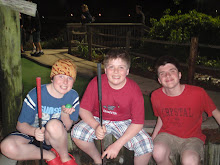
I have included pictures of my boys below at the beach. This is what we love to do these days. This was on a spring break vacation. My youngest sons favorite toy was a palm branch he found the first day. Again, an item from nature that I didn't have to purchase that entertained him. Nice!!
My Favorites
- Scott
- Boating
- Summer in Northern Michigan
- Elk Rapids Public Schools
- Ice cream
- My horses
- My family
- Preschool children
- My 3 sons
- My 2 dogs
This is me with one of my preschoolers who has been with me 5 days a week for the past 2 years. He is moving to Ohio. It is difficult when they leave. Good news is he will be back in 2 years. He is also one of my favorites.



Tracy:
ReplyDeleteIn the United States, we are struggling with offering appropriate and equitable services to children who do not speak the language of the majority. In Belize, they are struggling with maintaining a connection to their own native language due to education policies. I think this speaks to the importance of being culturally sensitive and responsive for the benefit of all children.
LouAnn Rhodes
Tracy,
ReplyDeleteI was interested to learn about Colombia's support of early childhod through payroll taxes. It is definitely a creative solution to funding early education. Somehow, this brings a whole new meaning to "it takes a village to raise a child"!
Thank you for sharing,
Teri